Activities and experiences
Things to do in Murchison Falls National Park
Two boat trips that leave from the same jetty and go in opposite directions, game drives across the Buligi grassland, a climb up the gorge to the lip of the falls, and Nile perch big enough to make the record books. Prices below are UWA's own, taken from the current tariff.
If you only want the answer
The boat to the base of the falls is the signature, the hike to the top is the better half of it, and the northern-bank game drives are where the lions live. Do all three and you have done Murchison properly.
The launch to the foot of the falls
UWA calls this the park's oldest and most popular excursion, and it earns the title. The boat runs upriver from the Paraa jetty to where the Nile pours out of Fajao gorge, and along the way it passes hippo pods almost continuously, crocodiles that grow larger here than almost anywhere on the river, elephant and buffalo coming down to drink, and a dense band of waterbirds on both banks. The boat stops short of the base of the falls, close enough to feel the spray.
It costs $30 for foreign non-residents, $25 for foreign residents, $20 for other African nationals and UGX 30,000 for East Africans. A launch takes a maximum of 45 people. The minimum charge on a small boat is US$120, which is eight passengers, so a couple wanting a private boat pays for eight seats.
On duration, UWA argues with itself. The tariff says the trip takes approximately two hours; the park brochure calls it a three-hour return trip. Private lodges also run their own boats alongside UWA's, on their own schedules. Budget two and a half to three hours and treat any single quoted figure as approximate.
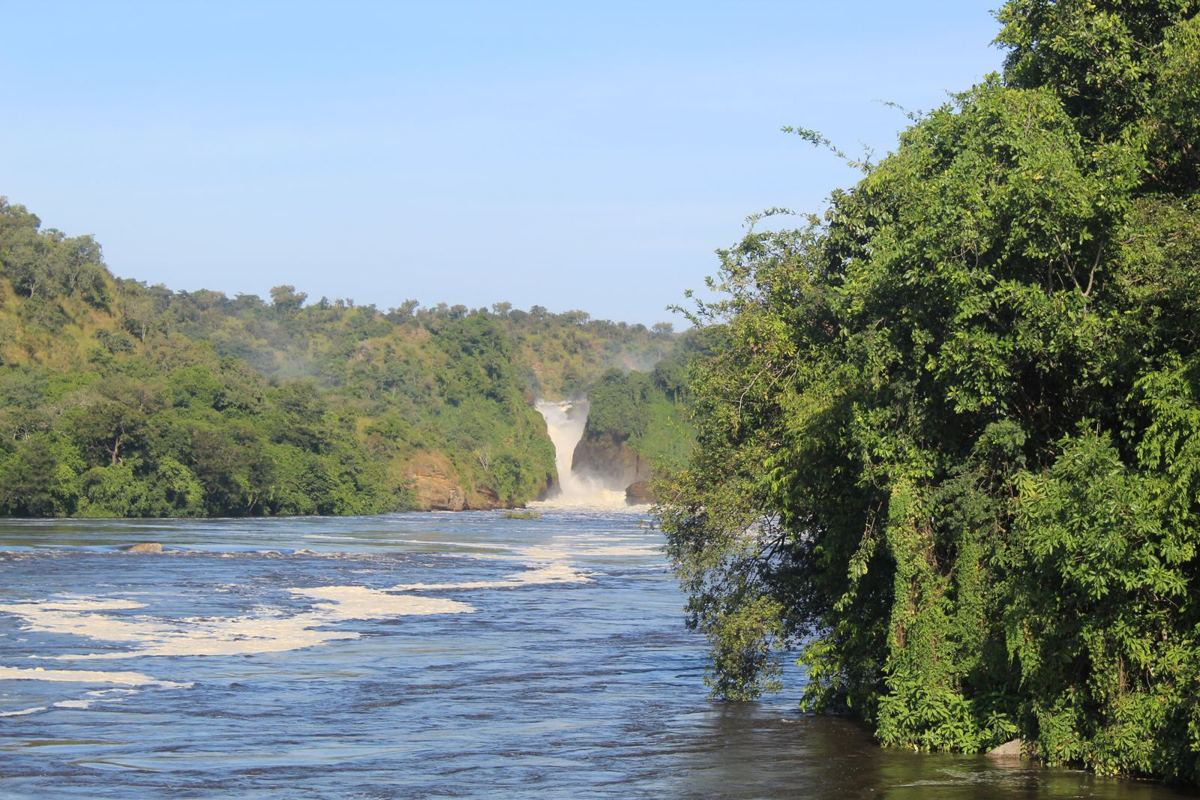
The delta cruise is a different boat, going the other way
This is the distinction that operator listings routinely blur. From the same jetty, boats also run downstream into the Nile delta, the braided maze of channels where the Victoria Nile spreads out and enters Lake Albert. It is a slower, flatter, quieter trip, and it exists for one bird above all.
The shoebill lives here, and UWA states that the delta is where it is best sighted, during the December to February and June to September dry seasons. NatureUganda's monitoring backs that up: sighting chances are higher in the delta than elsewhere on the Albert Nile. You will also see far more African skimmer, heron and stork here than on the falls run.
If someone offers you the boat trip without saying which direction it goes, ask. Falls and delta are different excursions, different lengths and different wildlife, and plenty of visitors book one thinking they were getting the other.
Game drives on the Buligi peninsula
The core game-viewing network sits on the north bank, in the triangle of grassland and borassus palms between the Victoria Nile and the Albert Nile, with the tracks converging at Delta Point. This is where the giraffe herds are, where the kob concentrations are, and where lion and hyaena densities are at their highest anywhere in Uganda.
The pricing is unusual enough to be worth reading twice. A day game drive with a UWA ranger guide costs $25 for the guide, not per person, so a full vehicle pays once. Driving your own circuit with no guide costs $10 per vehicle. Night drives cost $40 per person on the Murchison summary page, require a UWA guide, and are sold only to guests sleeping inside the park.
On the south bank, the tract known as the Heart of Murchison lies about 20 km east of the Masindi to Paraa road. It is the newer game-viewing area, with substantial Uganda kob herds and a reputation for lions. Note that giraffe were historically confined to the north bank, so a south-bank-only itinerary changes what you are likely to see.
Top of the Falls: two products, two prices
Online these get conflated constantly, and they are not the same thing. Hiking to the Top of the Falls means climbing up through Fajao gorge from the river with a ranger escort, and costs $15 for foreign non-residents, $10 for foreign residents and UGX 10,000 for East Africans. Simply viewing the Top of the Falls, having driven to the viewpoint, costs $10 for everyone and UGX 10,000 for East Africans. Ugandan pupils and wildlife clubs view it free.
The classic way to combine them is to take the launch upriver, step off at the base, walk up through the gorge with your ranger, and have your vehicle meet you at the top. It turns two separate activities into one continuous morning and it is the single best half-day in the park.
Chimpanzees at Kaniyo Pabidi
Kaniyo Pabidi, in the Budongo forest block in the south of the conservation area, holds a habituated chimpanzee group that can be tracked with forest guides. UWA's brochure advertises it. What UWA's tariff does not do is price it: the document lists chimpanzee tracking for Kibale and Kyambura only, and the Murchison fee summary has no chimpanzee line at all. Anyone quoting you a UWA price for Kaniyo Pabidi is quoting something that is not in the tariff, so ask who is actually setting and collecting the fee.
UWA's tracking rules apply wherever it runs the activity: a minimum age of 12, no entry to the forest if you are unwell, a minimum distance of 10 metres from the animals, a one-hour visit, no flash photography, and no eating, drinking or smoking while tracking.
Rabongo Forest, inside the national park on the south bank, is the other forest patch. UWA does not advertise chimpanzee tracking there.
Birding, in three separate places
A birding or nature walk costs $25 for foreign non-residents, $20 for foreign residents and UGX 20,000 for East Africans. A night nature walk costs $50. The park's birding splits cleanly into three theatres and they barely overlap.
The launch cruise gives you easy, close waterbirds along the banks. The delta gives you shoebill, saddle-billed stork and skimmer. And Kaniyo Pabidi forest gives you restricted-range forest species that exist nowhere else on the itinerary, with UWA specifically naming chocolate-backed kingfisher, white-thighed hornbill and Puvel's illadopsis. Serious birders come for all three and give the park three or four days rather than two.
Fishing, cycling and the ones with conditions attached
- Sport fishing below the falls targets Nile perch, and UWA records the rod-and-line record for the park at a startling 108 kg. A permit costs $50 a day, $150 for four days or $300 for the year, and does not include park entrance. East Africans pay UGX 20,000 a day.
- There is an annual Murchison Falls Invitational Fishing Tournament, which has its own reduced boat entry rates written into the tariff.
- Cycling costs $30 for foreign non-residents, $25 for foreign residents and UGX 30,000 for East Africans.
- White water rafting appears in the tariff at $50, but it is restricted to professional rafters and needs prior booking. Guides that list it as a normal Murchison activity have confused this park with Jinja.
- Hot air ballooning over the plains north and west of Paraa appears in UWA's brochure, but that brochure is demonstrably old, and we have not been able to confirm the flights are currently operating. Ask your lodge before you build a morning around it.
- Commercial filming and photography costs 40 per cent of the activity and entrance fees, rising to 50 per cent of the activity fee if you fly a drone. Prior booking is required.
Park rules and the fines behind them
- Stay on the tracks. Off-track driving costs $150 per person in the vehicle and is billed to the driver.
- The speed limit is 40 km/h. Speeding, littering and sounding your horn each cost UGX 100,000.
- Hitting an animal on the road carries a $500 charge, and sitting on top of a moving vehicle costs $100.
- No campfires or camping outside designated sites, no pets, no firearms, and do not pick the vegetation.
- Gates run 07:00 to 19:00, and your entry ticket runs for 24 hours from the moment you pass through. Keep every receipt until you leave.