
The full field guide
Animals and wildlife in Murchison Falls National Park
This is the most important place on earth for Nubian giraffe, with about 2,250 of them, and the park that holds roughly four out of every five lions left in Uganda. Its delta has produced the highest spotted hyaena density ever recorded in Africa and a leopard density above the Sabi Sands. Every figure on this page comes from Uganda's own published surveys.
If you only want the answer
Uganda's biggest park carries its biggest giraffe population, lion on the northern grasslands, elephant recovering from the war years, and the Nile itself stacked with hippo and crocodile. The delta downstream is one of Africa's most reliable shoebill stakeouts.
Nubian giraffe: the largest population left in the world
Start here, because nothing else in the park competes with it. UWA's State of Wildlife Resources in Uganda 2026 puts 2,250 Nubian giraffe in Murchison Falls, out of a national total of 2,519. The Giraffe Conservation Foundation reaches the same figure independently and calls this park, particularly its northern half, home to the largest population of Nubian giraffe left in the wild.
In 2010 fewer than 300 survived in the whole of Uganda. Every other Nubian giraffe population in the country was seeded from here, including the herd on Murchison's own southern bank, where giraffe had never been recorded before 2016.
The animal has had three names in twenty years, it is the only giraffe born with five ossicones, and its plain cream lower legs make it the one species here you can identify at any distance. We have put all of that, with the population history and what threatens it, on a page of its own.
What animals you'll see: sighting odds on a three-night visit
Green means you would be unlucky to miss it, amber and terracotta mean it depends on the drive and the day, and grey means the species is not here whatever you have read elsewhere. These odds assume a normal itinerary: two or three game drives on the northern bank around Buligi and the delta, the launch cruise to the falls, and perhaps a delta cruise or a night drive.
Species totals in UWA's own publications do not agree. The brochure says 76 mammal species, the General Management Plan says 109 in total of which 54 are large mammals, and the website says 144. We use about 76, with around 54 of them large enough to matter on a game drive, and flag the website figure so you know where it comes from.
- Hippopotamus Guaranteed Continuous along the Nile; the launch settles it
- Nile crocodile Guaranteed Exceptionally large below the falls
- Nubian giraffe Guaranteed About 2,250, concentrated on the north bank
- Uganda kob Guaranteed Around 35,000, the commonest antelope here
- Buffalo Guaranteed Large herds, often at the water
- Waterbuck Guaranteed Abundant on the river and delta tracks
- Warthog Guaranteed Everywhere, including around Paraa
- Olive baboon Guaranteed On the roads and around Paraa
- Vervet monkey Guaranteed Around lodges and picnic sites
- African elephant Very likely Ranges widely; best along the river
- Lion Very likely 240 in the park; Uganda's best odds by far
- Spotted hyaena Very likely Densest recorded anywhere in Africa
- Jackson's hartebeest Very likely North-western grasslands
- Oribi Very likely Northern short grass; small and easy to miss
- Bushbuck Good chance Shy, in riverine thicket
- Patas monkey Good chance North-bank savanna; absent from UWA's own records
- Chimpanzee Good chance Only on a Budongo trek, never on a game drive
- Leopard Takes luck Very high density, very low detectability
- Side-striped jackal Takes luck Uncommon and largely nocturnal here
- Zebra Not here Only four Ugandan reserves hold them, not this one
- Cheetah Not here In Uganda confined to Karamoja, far to the east
- African wild dog Not here Gone from Uganda since the 1980s
A south-bank-only stay changes the giraffe line from certain to possible, because the species was historically confined to the north bank and the southern animals were translocated there only in 2016 and 2017. Species silhouettes from PhyloPic (CC0, CC BY and CC BY-SA).
Lions: four in five of Uganda's entire population
Uganda's national large-carnivore action plan, published in 2024 and built on a 2022 spatial capture-recapture survey, estimates 240 lions over the age of one in Murchison Falls, across an effectively sampled area of 4,059 square kilometres. That is a density of 7.43 lions per 100 square kilometres, rising to 15.21 per 100 square kilometres in the Nile delta, and it came from 13,442 kilometres of driving, 40 call-up stations and 181 detections of 57 identified individuals.
Now the comparison. The same survey found 39.72 lions in Queen Elizabeth and 12.44 in Kidepo Valley, against a national total of 291. Murchison therefore holds roughly 82 per cent of the lions left in Uganda, which is a striking fact that almost no guide to this park states. The survey could not reach the south-eastern sector or the Budongo areas by vehicle, so 240 is a floor rather than a ceiling.
The trend matters as much as the number. Uganda's lions fell from 373 in 2020 to 291 in 2022 and 2023, with the sharpest declines in Kidepo and Queen Elizabeth, while UWA reports Murchison's population as remaining relatively stable. Historically the park's counts have swung widely, from several hundred in the early 2000s to a low of 132 in a 2009 playback survey, 215 in 2018, and 240 now. If you want lions in Uganda, this is where the arithmetic points.
The delta holds two records
A camera-trap study of the Nile delta region ran for 59 days from April to June 2022, across 32 camera locations and 1,603 trap nights, and the results are extraordinary. It produced 99 detections of 27 individual leopards, ten males and seventeen females, giving a density of 14.06 leopards per 100 square kilometres. The authors state that this is not only the highest leopard density in Uganda but among the highest across most of the species' range in Africa, and they name the Sabi Sands in South Africa at 11.8 and Matusadona in Zimbabwe at 12.2 as the closest comparisons.
Read that carefully before you get your hopes up. Density and detectability are different things, and leopard here remains a matter of luck; a night drive is the one thing that materially shifts the odds. What the number does tell you is that the delta functions as a genuine source population, which the authors credit partly to sustained de-snaring work by UWA and its NGO partners.
The same survey produced a spotted hyaena density of 45.31 per 100 square kilometres, around 161 animals inside the effective sample area. The authors describe it as not merely the highest in Uganda but the highest ever recorded using this method anywhere in Africa. Their conclusion about the delta as a whole is that it holds an intact guild and a source population of large carnivores, which is a rare thing to be able to write about an East African savanna in 2026.
Elephant, and why UWA's own numbers conflict
UWA's park page says an aerial survey counted over 900 elephants with numbers steadily increasing. UWA's own management plan gives 1,617 from a 2012 aerial count. Those are not reconcilable from the documents available, and both are UWA's. Treat the population as somewhere in the region of 1,000 to 1,600 and do not be surprised to see either figure quoted.
The historical series is grim and then encouraging. Around 12,000 elephants lived here in 1971. By 1980, after a decade of poaching and civil conflict, 1,420 remained. The count reached 516 in 2005, 904 in 2010 and 1,617 by 2012. Nationally Uganda holds 6,352 elephants in the most recent 2023 to 2025 figures, down four per cent on the previous survey, with Queen Elizabeth the largest population and Murchison the second.
The grazers that fill the northern grassland
| Species | The numbers |
|---|---|
| Uganda kob | Around 36,200 counted in 2012 and about 35,000 claimed on UWA's website, within a national population of 175,109. Murchison and Queen Elizabeth are the two strongholds, and the breeding leks are a management-sensitive feature of the northern grassland. |
| Buffalo | 7,506 in the 2012 count, with UWA's website now claiming over 10,000. The national herd has been growing at about 8.8 per cent a year since 2022. |
| Jackson's hartebeest | Collapsed from 14,000 in 1980 to a fraction of that, then recovered to 6,263 by 2012. Found in the north-western sector. The national figure is 10,414. |
| Waterbuck | 6,648 in 2012 and reliably seen along the river, out of 22,623 nationally. |
| Oribi | Murchison's northern short-grass country is among the best oribi habitat in Uganda. Nationally the species has slipped from 13,851 to 11,005. |
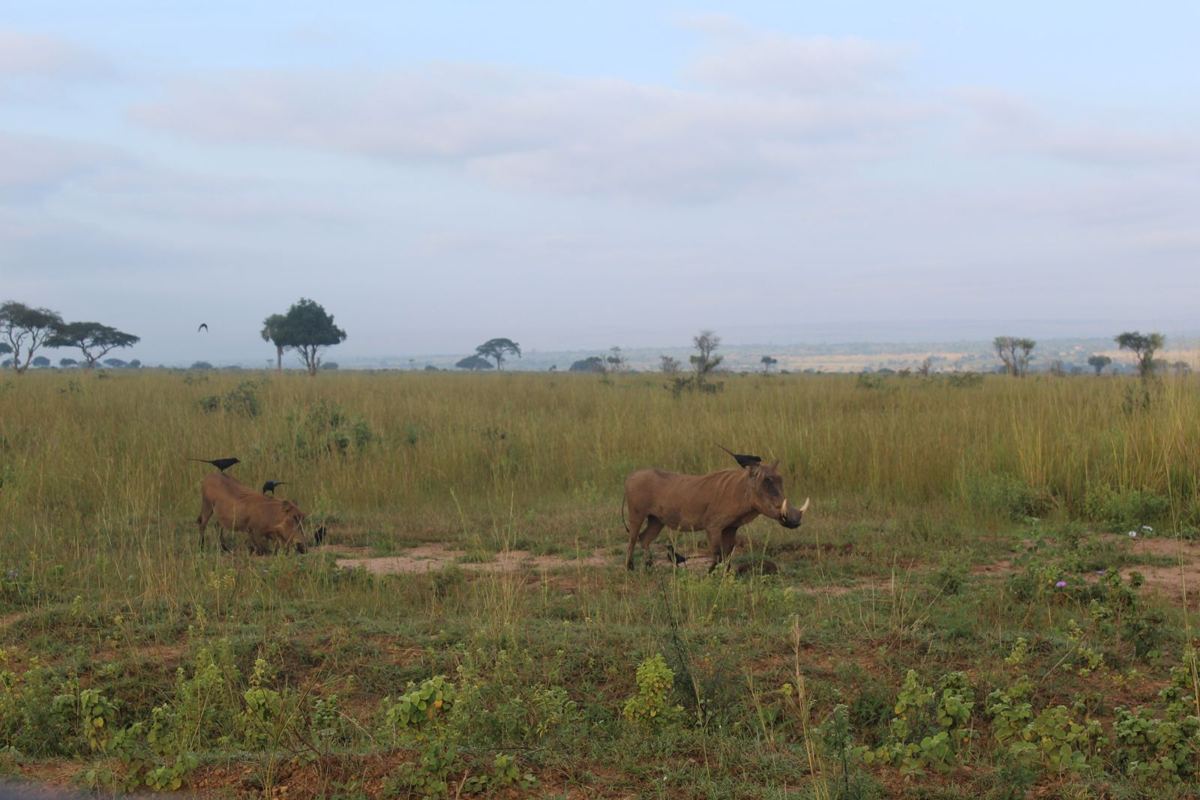
| Warthog | 2,508 in 2012, and in practice the animal you will see most often around the lodges and Paraa itself. |
Historical counts are from UWA's General Management Plan, with the July 2012 aerial count as the final column of its own series. National totals are from State of Wildlife Resources in Uganda 2026.
Hippo and crocodile: the reason the boat trip works
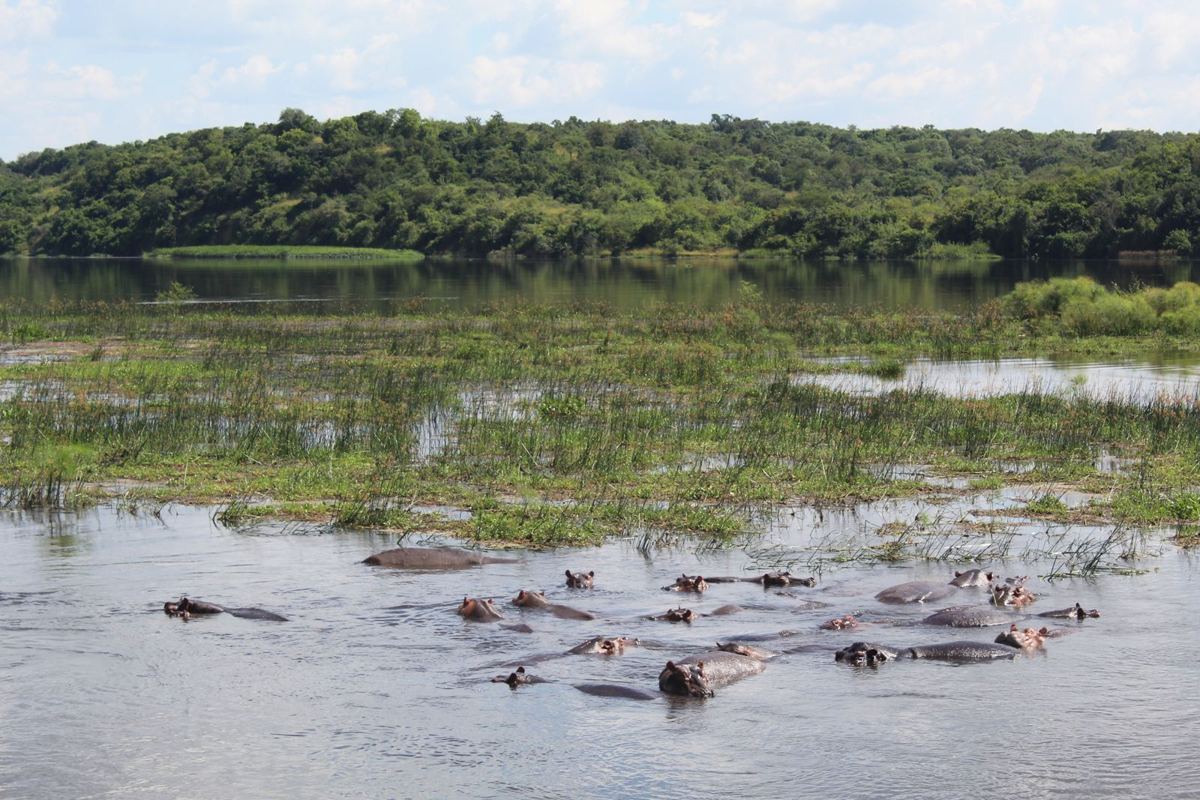
Paraa means home of the hippo, and the stretch of Victoria Nile between the falls and the delta, which is exactly the stretch the launch cruise covers, is where they concentrate. Uganda's hippo population stands at 9,026 in the 2023 to 2025 figures, up almost ten per cent in three years, though more than 77 per cent of the national total sits in the Queen Elizabeth conservation area rather than here.
Crocodiles are the other certainty. UWA's management plan says Murchison is famous for its crocodiles, that they grow exceptionally large in the river below the falls, and that the protected area still supports the largest crocodile population in the country. The most recent study, from 2023, counted 1,110 crocodiles across the Victoria Nile, the Albert Nile, the park and Lake Victoria combined. Long-term monitoring shows a decline since the 1960s with localised recovery on the Victoria Nile.
Birds: around 450 species, and one everybody comes for
Use around 450 species for the national park itself. UWA's brochure says over 451 and its management plan says over 450, while its website now claims 556. The higher figure most plausibly covers the wider conservation area including Budongo forest, whose avifauna adds a large block of species that never occur in the savanna. Both numbers are UWA's, which is why we give you both and tell you which applies to what.
NatureUganda's 2019 monitoring for UWA recorded 184 land bird species across fourteen sites in the park, 149 of them at eight sites north of the Nile and 129 at six sites south, with Waiga River and North 1 the richest. Beyond the top five, look for African skimmer in the delta, goliath heron along the banks, and red-throated bee-eater and pied kingfisher breeding in colonies on the sandbanks below the falls. Chocolate-backed kingfisher and white-thighed hornbill are the other Kaniyo Pabidi draws.
One correction while you are here. Uganda has exactly two endemic bird species, Fox's weaver and the Karamoja apalis, and neither of them occurs at Murchison. Any guide promising you Ugandan endemics in this park is wrong.
- Shoebill Globally Vulnerable and Endangered on Uganda's national list. The Nile delta is one of the most reliable sites in Africa, best in the December to February and June to September dry seasons
- Rüppell's vulture Critically Endangered, recorded in the park's northern open country; UWA's 2026 report illustrates the species with a photograph taken here. White-headed vulture, also Critically Endangered, turned up in the same survey
- Puvel's illadopsis A restricted-range forest skulker that UWA names as one of Kaniyo Pabidi's specialities, and the reason forest birders detour into Budongo
- Saddle-billed stork UWA's management plan names the Nile and its delta as a breeding area for this species, not merely a place it turns up, which is what raises it above a normal sighting
- White-crested turaco A northern savanna species at the edge of its range, named on UWA's park page as a Murchison signature. A genuine range tick rather than a bird you would pick up elsewhere in Uganda