
The park's headline animal
The Nubian giraffe, once called Rothschild's
Around 2,250 of them live in Murchison Falls, the largest population left anywhere in the wild. Fifteen years ago there were fewer than 300 in the whole of Uganda. This is what the animal is, why it has had three names, and where the recovery came from.
One animal, three names
If you have read about giraffe in Uganda you will have met all three names, often on the same page, and they refer to the same animal.
Rothschild's giraffe was described as its own subspecies and named after Walter Rothschild. Genetic work later found it indistinguishable from the Nubian giraffe, and because Nubian is the older name it took precedence. Rothschild's stopped being a valid taxon and became a local population of Nubian giraffe.
Then on 21 August 2025 the IUCN Species Survival Commission's Giraffe and Okapi Specialist Group ended more than a decade of argument and recognised four giraffe species rather than one. Nubian giraffe now sits as a subspecies of the northern giraffe, Giraffa camelopardalis. That is why signs in the park, guidebooks and some of the Uganda Wildlife Authority's own material still say Rothschild's: the animal did not change, the classification did, twice.
How to recognise one
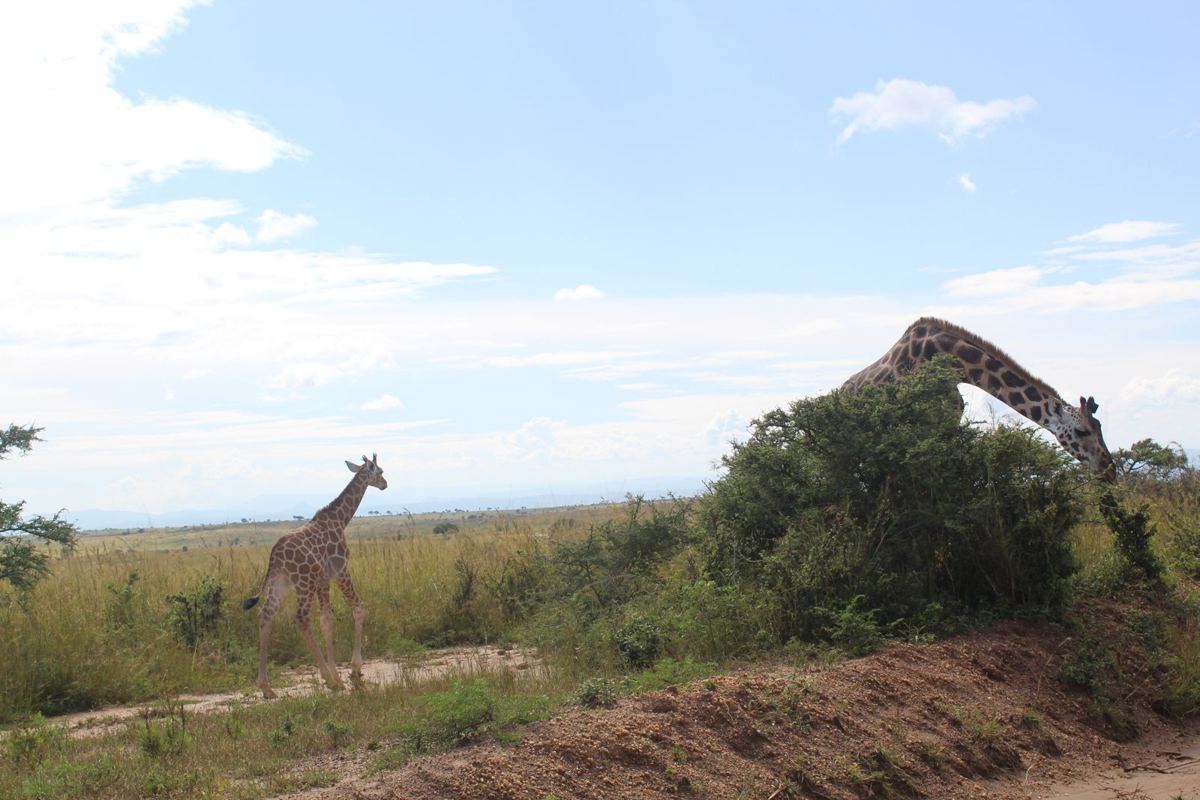
The lower legs are the giveaway. Nubian giraffe carry large chestnut patches with sharp, largely complete edges, and the spotting stops around the hocks and almost never reaches the hooves. The result is a pair of plain cream legs that look like white socks, and no other giraffe in East Africa wears them.
Look at the head as well. This is the only giraffe born with five ossicones rather than two: one extra in the middle of the forehead, and a smaller pair behind the ears. On an old bull the central one is obvious once you know to look for it.
The patches themselves often have paler lines radiating inside them, which is easiest to see in flat morning light rather than at midday.
Where they live now, and how many
The Uganda Wildlife Authority's State of Wildlife Resources in Uganda 2026 counts 2,250 Nubian giraffe in Murchison Falls, out of a national total of 2,519 spread over four protected areas. The Giraffe Conservation Foundation arrives at the same figure independently and calls the park, particularly its northern half, the largest population of Nubian giraffe in the wild.
The scale of the recovery is the part worth sitting with. In 2010 fewer than 300 survived in the whole country, in two populations. The national count then climbed through 880, 2,072 and 2,414 to today's figure.
Counts appeared to dip between 2023 and 2025. UWA's own reading is that habitat change is reducing visibility in a heavily invaded park rather than that animals are being lost. Monitoring here no longer relies on aerial counting: individual giraffe are identified from their coat patterns using pattern-recognition software, so the same animal can be recognised year after year.
Murchison is where the others came from
Every other Nubian giraffe population in Uganda traces back to this park. Fifteen animals went to Lake Mburo in 2015. Thirty seven were moved across the Nile onto Murchison's own southern bank during Operation Twiga I and II in 2016 and 2017. Fourteen went to Kidepo in 2018, and more followed to Pian Upe in 2019 and 2020.
The river crossings mattered more than the numbers suggest. UWA's management plan records that giraffe had never been documented south of the Victoria Nile before that translocation, so the southern bank herd is a deliberately created population rather than a recovered one.
Seeing them
The northern bank grassland is where the density is, and giraffe are among the easiest large animals to find there because they feed standing in the open and are visible at a distance. You do not need luck for this one, which is not something we can say about the park's lions or leopards.
Early morning gives you the light that shows the coat pattern properly and the hours when the animals are moving rather than standing out the heat. Our wildlife page sets out the realistic odds for everything else in the park on a three-night visit.
What threatens them
The Giraffe Conservation Foundation names two pressures: snare poaching, which catches giraffe that were not the intended target, and oil extraction inside and around the park. Neither is hypothetical here.
The Foundation is now mapping the park's seasonal giraffe movements for the first time, which matters because you cannot route infrastructure around an animal whose movements nobody has recorded.